
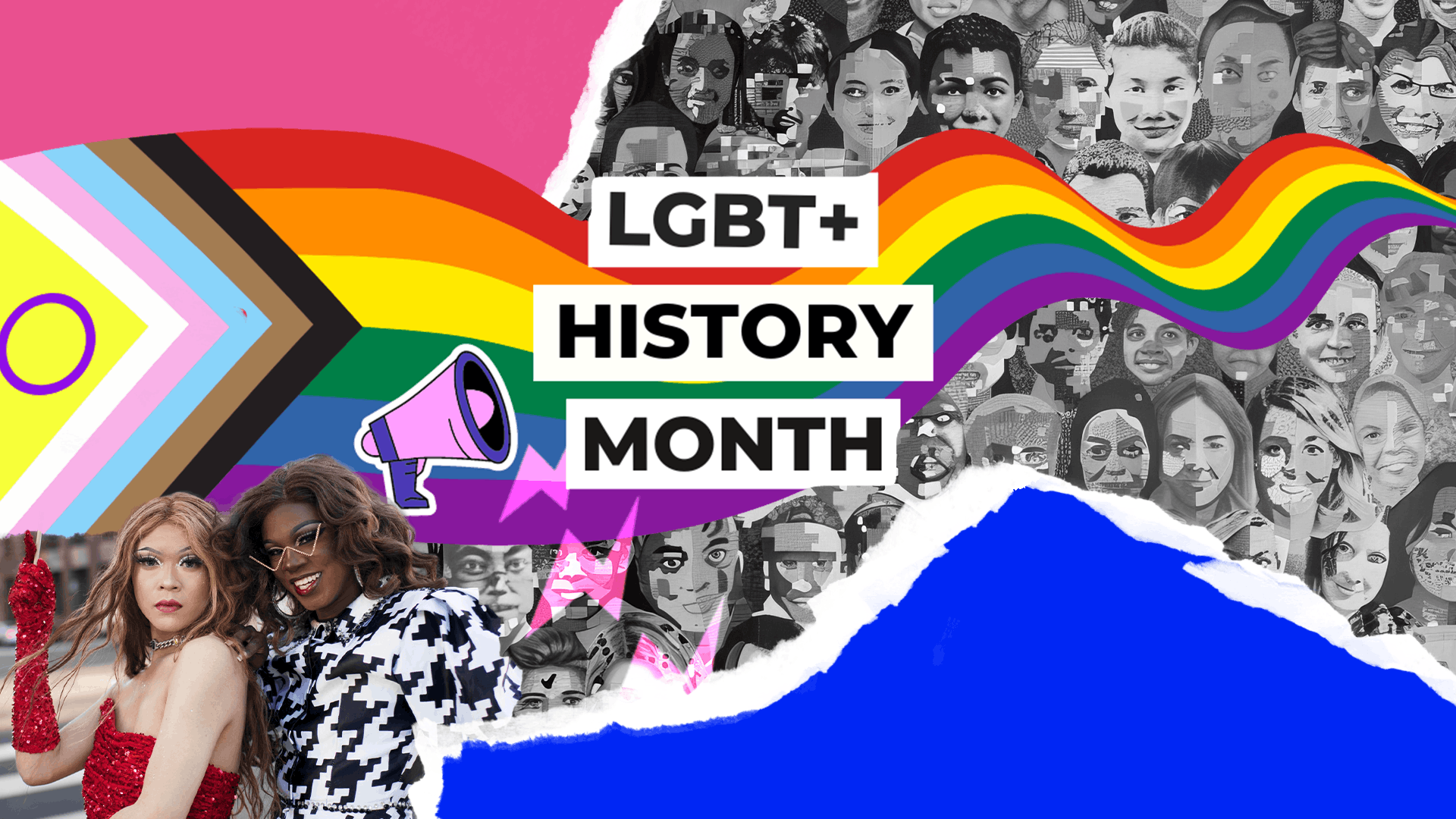
LGBT+ History Month: Why it Matters
LGBT+ History Month is a moment to pause and look more closely at the stories that haven’t always been centred.
It’s about recognising the people who have shaped our world, often without credit, visibility or protection. And when it comes to science and innovation, that includes a long history of queer people whose contributions were overlooked, downplayed or quietly absorbed into the mainstream without acknowledgment.
Queer people have always been innovating. We’ve always been here.
What feels different now is that we are starting to name that history more openly. To connect the dots between identity, experience and impact. And to ask better questions about who we celebrate when we talk about progress.
This year’s LGBT+ History Month theme, Science and Innovation, feels especially relevant. Not because queer people are new to these fields, but because recognition, context and visibility still matter.
Especially now.
Innovation has never belonged to one type of person
Innovation rarely comes from repeating what already exists.
It tends to come from people who notice gaps, question assumptions and approach problems from unexpected angles. For queer women, non-binary people and trans individuals, that way of thinking is often shaped by lived experience.
Navigating the world differently changes how you see it. It sharpens your awareness of what works, what does not, and what could be reimagined.
But there is not enough representation. People who openly identify as LGBTQ+ are currently estimated to make up only 2-3% of the tech sector. So we want to champion a few friendly queers who happen to be exceptional in their fields.
The queer people shaping our world
When it comes to science and innovation, queer women, non-binary people and trans individuals are still too often missing from the narrative.
We’ve focused on a few people whose work has helped shape the world we live in today. People who are expanding what innovation looks like. Some of whom we’ve had the pleasure of working with ourselves…
Nergis Mavalvala
Astrophysicist Nergis Mavalvala helped change how we understand the universe.
As a key figure in the Laser Interferometer Gravitational-Wave Observatory, she played a central role in the first-ever detection of gravitational waves. A discovery that confirmed a major prediction of Einstein’s theory of relativity and opened up an entirely new way of observing space.
She is also openly lesbian. And vocal about the importance of visibility.
Now Dean of MIT’s School of Science, Mavalvala has spoken about how her identity and her work coexist. Her career stands as a reminder that scientific brilliance does not come in one shape, background or identity.
Shrouk El-Attar
Shrouk El-Attar is a queer electronics engineer, creative technologist and refugee advocate whose work refuses to stay in one lane.
With a background in PCB design and engineering, Shrouk combines technical expertise with movement, performance and storytelling to advocate for LGBTQ+ rights and refugee inclusion. She was named one of the BBC’s 100 Women, but her influence reaches far beyond awards.
Her work challenges the idea that science must be detached or purely functional. Instead, it shows how creativity, emotion and technical skill can coexist.
Shrouk’s approach feels especially relevant in a world where innovation is often talked about as something purely technical, rather than deeply human.
Protea Vale and the team behind Space Pride
Who is making space more equitable for LGBTQ+ individuals? Space Pride is Protea Vale (they/she), the organisation’s founder and a self-described creative futurist is leading that mission.
Protea’s work invites us to think about space not just as a technological frontier, but as a cultural one. One shaped by the same power dynamics and exclusions we see on Earth, unless we actively choose to do things differently.
Space Pride’s work is supported by a wider leadership team, including Khush Shah (Creative Director), Scott Scoular (President), Rania Djojosugito (Operations Director), and Naveed Moeed (Treasurer).
Together, they are challenging an industry that has historically been slow to address issues of diversity and inclusion, and pushing it to imagine a more representative future.
Working with Space Pride
Innovation does not stop on Earth. And neither should inclusion.
Space Pride is a global initiative working to make the space sector safer and more inclusive for LGBTQ+ people.
We supported Space Pride with a rebrand that would take them into the stratosphere. Our work with them was pro bono - we are committed to support LGBTQ organisations throughout the year whether that’s through pro bono work, collaborations or featuring LGBTQ+ charities in our events.
Why this matters to us
The same systems that limit who gets access to science and innovation also shape whose ideas are funded, whose leadership is trusted and whose stories are told.
When organisations default to sameness, they do not just exclude people. They limit possibility.
At I Am Female*, we believe that diverse perspectives strengthen creativity. They lead to more thoughtful storytelling, more relevant work and ideas that reflect the world as it actually is.
Supporting organisations like Space Pride, amplifying queer innovators and celebrating LGBT+ History Month with intention is part of how we live those values.
Looking ahead
LGBT+ History Month is about remembering, but it is also about noticing patterns.
Who has been celebrated.
Who has been overlooked.
And who we choose to make space for moving forward.
This year’s focus on Science and Innovation reminds us that the future is already being shaped. Inclusion needs to be part of that process from the beginning, not added as an afterthought.
So as we reflect this month, we are holding one question close.
What kind of future are we helping to build, and who are we building it for?
If you care about thoughtful leadership, inclusive creativity and stories rooted in real impact, we would love you to be part of our community.
Sign up to our newsletter below for more reflections, insights and conversations like this.


Go on… steal all of our brilliant ideas


Go on… steal all of our brilliant ideas
Fancy some emails you’ll actually want to read? Sign up for our newsletter and we’ll slide into your inbox with insights on how you can make your brand hotter than Dante's inferno.