

The Commercial Case Every Marketer Needs to Make
What does authenticity even mean anymore?
Almost every brand claims it, but it’s become the latest buzzword that most brands can’t define. Ask ten marketers and you’ll get ten variations of “being real” or “a genuine voice”. Ask ten consumers and we get into brand specifics. Does the brand do what it says it does? Does it behave consistently whether or not it is being watched? Does it stand for something other than selling?
This gap between how brands think about and how customers experience authenticity is where brand trust is built or destroyed. If you’re getting it wrong in 2026, you’re risking your reputation and your revenue. If you want to know what brand authenticity actually means, and how to build it, we’ve written about that here. In this post, we get into the commercial case. The data, examples, and measurement framework, and the argument every marketer should be making to the people who control the budget.
Brand authenticity is a top-five CMO priority. So why are most brands still treating it like a nice-to-have?
McKinsey’s 2025 research into European marketing leadership found that authenticity ranked fourth among CMO priorities. And four of the top five priorities pointed to long-term brand and trust building over short-term activation. This reflects a shift in where senior marketing leaders see a competitive advantage.
The data on delivering commercial authenticity is also clear. According to a recent Clutch consumer survey, 97% of consumers say authenticity is a key factor in their decision to support a brand. 85% have purchased from a brand specifically because it felt authentic, 81% have stopped supporting a brand because it no longer felt genuine, and 70% are willing to pay more for brands they perceive as authentic.
So why aren’t more marketing teams taking brand authenticity seriously?
Part of the reason is the word itself. We see the word “authenticity,” and we roll our eyes; it’s in every brand guidelines, every social media caption, and every blog post (guilty). When a word is thrown around like confetti, it loses its meaning. Authenticity has become an abstract concept when it should be a consistent and credible experience for customers. Data should show that your customers trust you enough to keep buying from you.
Redefining brand authenticity
The current meaning is not working. We’ve created a sharper definition with commercial teeth:
Brand authenticity aligns a brand’s promises with what it consistently delivers. Across marketing, products, services, internal culture, and behaviour. It’s about your business values and purpose, and about how your marketing looks and sounds.
For marketers who want to move beyond vague principles, a useful academic framework is The Perceived Brand Authenticity Scale. This breaks brand authority into four dimensions: continuity, credibility, integrity, and symbolism. Of these four, the most commercially critical to get right first are credibility and integrity. If your brand isn’t delivering on promises, or if your internal and external cultures are disconnected, your customers will see you as vapid. A brand with a beautiful strategy document and an incoherent customer experience has a credibility problem. One whose team members do not live the brand values it promotes publicly has an integrity problem. Fix those before you worry about continuity or symbolism.
The brands that consistently score highest on authenticity metrics are not the ones with the most polished brand guidelines. They’re the ones that align internally and externally. The ones with team members who genuinely believe in the brand, where quality products and services back up every claim, and where the brand behaves the same way in quiet months as it does during a campaign.
The audiences most companies underestimate, and why it matters commercially
Today’s consumers are generally more discerning than they were a decade ago. And there are specific communities that spot and call out inauthenticity. Earning their loyalty is especially valuable.
These are communities that have historically been marketed at rather than marketed with. Those who have seen their language, aesthetics, and identity borrowed by companies with no connection to them. These communities know the difference between a brand that shows up because it cares and one that’s performing for a commercial opportunity. This has a practical implication for marketers; if you are trying to connect with a community that is sceptical of brands, performative marketing is damaging. It shows that you do not understand the people you are claiming to serve.
So how do you achieve actual authenticity?
By co-creating with the communities you want to connect with. Involve them in shaping your brand narrative; what it says and how it says it. Running a finished campaign by them for sign-off won’t cut it. The brands that build genuine consumer trust with discerning audiences are the ones that treat those audiences as collaborators.
And yes, diversity and inclusion are important, but that’s not the point here. Community inclusion is the only way to achieve brand authenticity. The brands that get this right build the kind of brand loyalty that acquisition campaigns cannot replicate. The brands that get it wrong lose customers in ways that are difficult and expensive to reverse.
Brand authenticity examples: what it looks like when it is working
Clever marketing campaigns have their place, but the brands that show real authenticity are the ones that are authentic in operational decisions, internal culture, and customer experience, not just marketing.

Patagonia: credibility backed by action
Patagonia is the brand example that every authenticity post uses, and for good reason. Its founder, Yvon Chouinard’s, values around environmentalism and anti-consumerism are inseparable from the brand’s identity. Patagonia has made business decisions for decades that most companies would never countenance. Their “Don’t Buy This Jacket” Black Friday campaign, a full-page New York Times ad showing the environmental cost of producing a single jacket, is perhaps the most dramatic instance of a brand working against short-term commercial interest to gain long-term brand trust.
And it worked. Sales increased by 30% in the nine months following the campaign.
Patagonia’s credibility comes from decades of operational consistency – supply chain transparency, repair services, and its 2022 decision to transfer ownership to a trust whose purpose is fighting environmental change. The brand lives its values.
Takeaway: Authentic brands live their values beyond their marketing campaigns; they show up in every business decision.
Ben & Jerry's: integrity through consistency
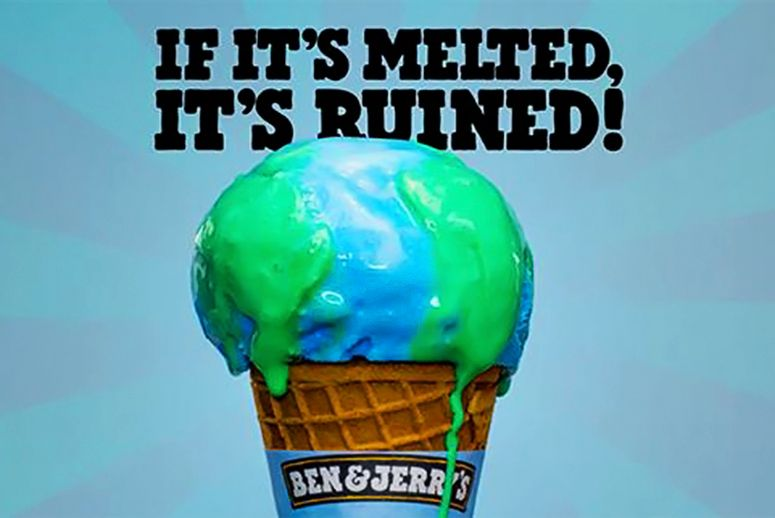
Ben & Jerry's is not a small business, but its approach to brand authenticity shows integrity at scale. The brand has been outspoken on social and political issues for decades, because the founders genuinely hold those values and built the company on them.
Ben & Jerry’s is consistent in their beliefs. They have taken positions that have cost them commercially, and have maintained them under pressure from their parent company. Unilever and Ben & Jerry's relationship has been publicly complicated because the brand refuses to let corporate ownership dilute its integrity. This is what makes their brand authenticity credible.
Takeaway: Consistency under pressure shows genuine brand authenticity. Any brand can hold a values position when it is popular; the test is if they hold it when it costs them something.

Victoria's Secret: authentic reinvention
For decades, Victoria’s Secret built an identity around a narrow and exclusionary definition of beauty that became increasingly misaligned with what its actual customers wanted. What the brand said it stood for and what customers experienced were disjointed, causing a credibility and integrity problem. The commercial consequences were significant; revenue fell, and customers started shopping elsewhere.
To correct this, they listened to the people who had been telling the brand what was wrong for years. They restructured their mission, took on new spokespeople, and developed inclusive sizing. They acknowledged the issues with their old identity and changed their behaviour.
The difference between authentic and performative reinvention comes down to internal change. For Victoria’s Secret, their new product range, partnerships, and the team’s composition shifted.
Takeaway: Reinvention is authentic when it follows, not precedes, internal change. Today's consumers will clock which one they are looking at a mile off.

Paynter Jacket: small brand, maximum authenticity
Paynter Jacket is a small UK clothing brand that has built brand authenticity through radical transparency and a model that is almost entirely antithetical to most consumer brands. They manufacture in limited drops and share detailed information about their supply chain and production costs. They consider their communication with their community, and never come across as corporate.
Paynter shares stories about their jacket-making process, including the problems. They are transparent about their product and who it’s for, resulting in a customer relationship built on genuine trust.
Smaller businesses often believe that authenticity is easier for them than large companies. In some respects they are right; the founder is closer to the product, the team is smaller, the culture is more visible. But the principles are identical. If the internal culture matches the external persona, the authenticity is there.
Takeaway: Solid brand foundations create authenticity, regardless of the company’s size.
The cost when brand authenticity breaks down
Brand authenticity rarely comes crashing down overnight. Decisions that prioritise commercial interest over consistency over time chip away at it until what brands say and do is noticeably no longer aligning.
The most common cause of this comes internally. If a team isn’t living the brand or the internal culture has decoupled from the external project values inauthenticity eventually surfaces. This can look like a bad customer experience, an off social post, or a campaign that doesn’t land.
81% of consumers have stopped supporting a brand because it no longer felt genuine, and more than half (52%) say they would stop buying from a brand after an inauthentic experience.
These three cases show what this looks like at scale.
H&M's greenwashing controversies – the brand made repeated sustainability claims that were misleading or unsupported by its actual practices, creating a credibility problem that advertising spend could not solve.
Pepsi's 2017 Kendall Jenner campaign attempted to align the brand with social justice movements it had no connection to. Bad idea. The backlash made Pepsi pull the campaign after just one day, showing that brands should never borrow the language of a movement it has not earned the right to represent.
Volkswagen's emissions scandal is the most extreme instance. A brand whose values around engineering excellence and environmental responsibility were directly contradicted by corporate behaviour, resulting in broken trust and severe commercial damage.
These three brands show the danger in behaviour that contradicts a brand’s stated values. Every time, it will result in commercial consequences.
The AI authenticity crisis, and why most marketing teams have not connected the dots yet
AI is creating a sceptical economy. It’s hard to believe in a brand’s authenticity if you don’t even know if its content is real.
Only 7% of consumers say visible AI-generated marketing content makes them trust a brand more, while 31% say it makes them trust the brand less, according to data from Klaviyo and Datalily. A separate Gartner consumer survey of 377 US respondents found that 53% of consumers distrust AI-powered search results. This figure shows that AI-generated content is reshaping how audiences evaluate everything a brand produces.
But this doesn’t mean brands should stop using AI. Used well, with strong brand foundations, AI can boost a brand's voice and speed up content production while staying authentic. The problem with AI is when brands don’t know how to use it effectively or don’t have clear enough foundations to direct it.
AI-generated content at scale has a homogenising effect. When a brand's voice, values, and perspective are not specific or rigorous enough, AI defaults to bland. You get lightly salted content. Inoffensive and fine, but indistinguishable from every other brand. You’ll forget the content as soon as you’ve read it, meaning you’ll forget the brand and its distinctiveness it spent years building.
The brands that use AI well are the ones with the strongest brand foundations. They have clear tone of voice guidelines with real copy examples across multiple channels, documented values that show specific content decisions, and AI prompting guides that anchor output in the brand's identity. You can check out our post on how to build a brand voice robust enough to survive AI at scale here.
If you’re a marketer, you should be asking yourself, "does our AI-assisted content still sound unmistakably like us?" If the answer is uncertain, the brand foundations need strengthening before the content volume increases.
How to measure your brand's authenticity with a practical framework
Most teams don’t know how to measure authenticity and that’s why it doesn’t make it to the quarterly business review. So, we’ve created a practical framework built around the four dimensions of the Perceived Brand Authenticity Scale.
Credibility: are you delivering on your promises?
Start with this point – the most commercially immediate dimension. Measure it through NPS and customer satisfaction data, tracking whether the experience customers have matches what the brand promises. Review social listening data for the specific language customers use to describe the brand and compare it to the language the brand uses to describe itself. If there’s a large gap, you have a credibility problem.
Integrity: does your internal culture match your external messaging?
This is harder to measure but you need to get it right. Internal engagement scores, team member retention rates, and qualitative feedback from customer-facing team members provide data on whether the people building the brand believe in what it stands for. A brand whose team members are real advocates show up as externally authentic. A brand where the internal culture has decoupled from the external positioning will eventually show the gap.
Continuity: are you staying true to what made you distinctive?
Audit your last twelve months of content across all channels and ask: does this still sound like us? What decisions have we made in that period that connect to our brand's history and identity, and which ones contradict it? Your content should still reflect the same values and voice you had a year ago.
Symbolism: what do we mean to our audience?
This is the most qualitative dimension, but extremely valuable. Send out periodic customer interviews asking: what do you think this brand stands for? What kind of person buys from this brand? The disconnect between those answers and the brand's self-image is one of the most useful data points a marketing team can have.
Run this assessment quarterly for a practical way to track whether brand authenticity is being maintained or eroded. And for the data to make an internal case for the investment required to protect it.
What authentic brands do differently
If you look across the examples in this post, the patterns are consistent.
Every value is backed by solid proof. The words on the website and in the marketing campaigns are the same as the decisions being made in the boardroom and the supply chain. Actions really do speak louder than words, and authentic brands behave in ways that show their beliefs.
Team members understand and believe in what the brand stands for, and the internal reality is the source of their external positioning. When the team backs the brand, marketing follows naturally; when the team is not, creative production cannot fill the gap.
They are consistent across channels and time. The brand sounds the same in a customer service interaction as it does in a campaign. Consistency is one of the most important factors in building consumer trust, and one of the most difficult to maintain at scale without strong foundations.
They are willing to say who they are not for. You cannot be everything to everyone and authentic brands do not try to be. They carefully choose their audiences, position and values with deliberate exclusion. Today’s consumers know the difference between a brand with a point of view and a backbone and one that is trying to be everyone’s best friend.
They treat authenticity as a business performance metric. The most authentic brands are the ones whose marketing leadership has made the commercial case internally. They connect brand trust to customer retention, brand loyalty to lifetime value, and brand consistency to real talk that no acquisition budget can replicate.
The brands worth the most are the ones people actually believe
Brand authenticity is the sum of every decision a brand makes. This means there are eyes on every promise, every time the internal culture surfaces in the external experience, and every moment where a customer tests whether the brand is what it says it is.
The brands that get this right build genuine consumer trust. A trust that cannot be replicated by marketing spend. This trust is what makes customers choose you over a competitor who is offering the same thing, but cheaper or more convenient. They choose you because they also believe in what you stand for.
At I Am Female*, we build brands for the audiences that clock inauthenticity and stay loyal to the brands that earn it. If what your brand says and what your customers experience are detached, this is exactly the kind of problem we work on.
Book a call with us. Let's figure out where the gap is and how to close it.


Go on… steal all of our brilliant ideas


Go on… steal all of our brilliant ideas
Fancy some emails you’ll actually want to read? Sign up for our newsletter and we’ll slide into your inbox with insights on how you can make your brand hotter than Dante's inferno.